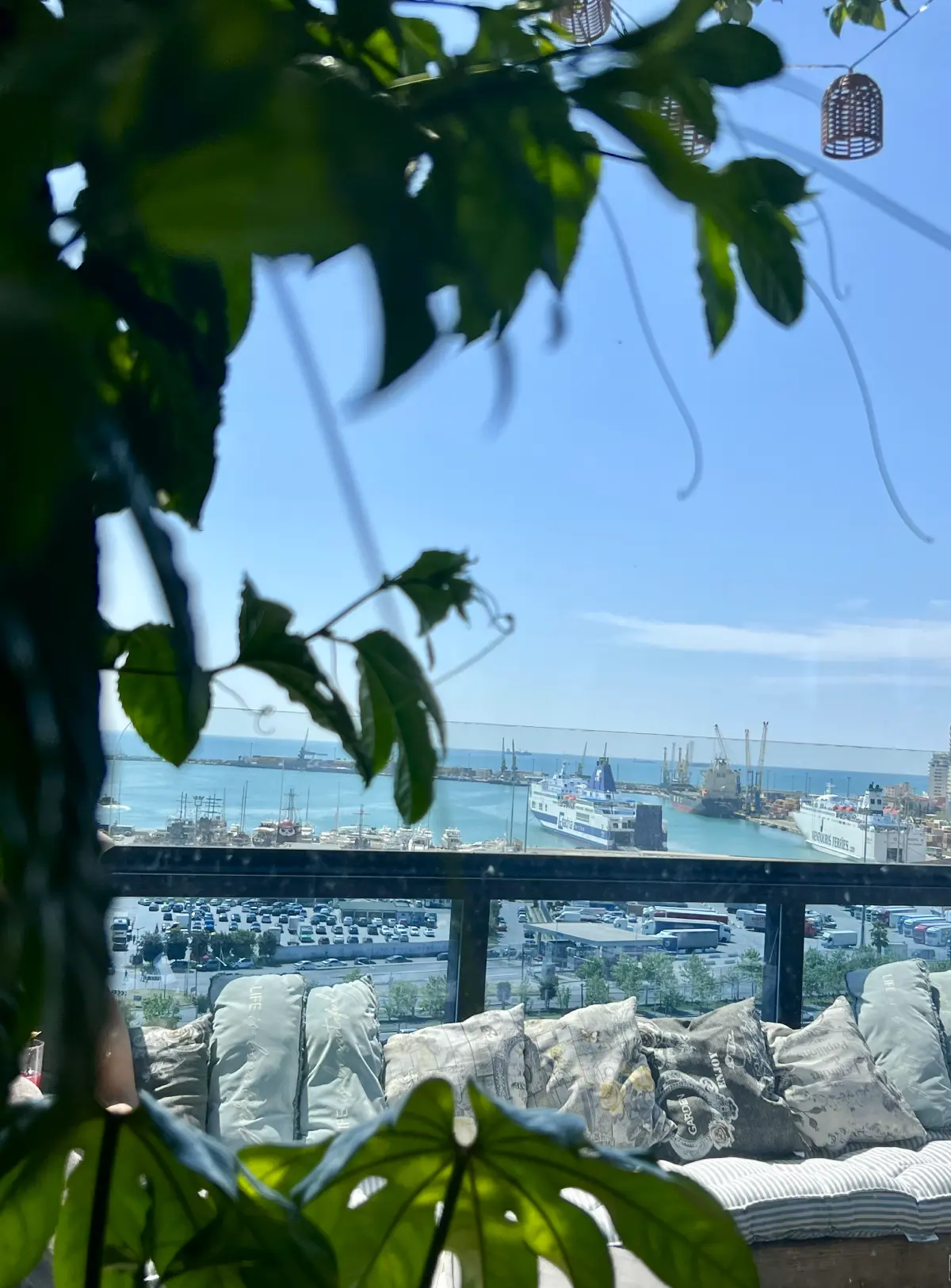
The overnight ferry from Bari gets in at about eight in the morning, and Durrës ferry port is not out in some industrial zone. It sits at the edge of the city centre, next to the railway station and the bus stops, fifteen minutes on foot from the old town. Here is what happens between the car deck and your first coffee, and how to move on to Tirana, the airport or the Riviera.
Which ferries arrive, and when
Two Italian ports have ferries to Durrës. Bari has the most: three companies share the route, at least one ship sails every night of the year, and in July and August there are daytime crossings too. Ancona has a single operator and a crossing of more than sixteen hours. Brindisi's ferries to Albania go to Vlorë, not Durrës, and there is no Trieste sailing this year.
| From | Operators | How often | Crossing | Arrives in Durrës |
|---|---|---|---|---|
| Bari | Adria Ferries, GNV, Ventouris | Every night, all year; day sailings too in July and August | About 10 hours | About 08:00, or 09:00 on some summer nights |
| Ancona | Adria Ferries | Tuesday, Thursday and Saturday, more in high summer | About 16½ hours | Late morning, or about 09:30 on Sundays |
Timetables change every season, so check your operator's before you book. Summer brings the biggest crowds and the delays. On the first busy weekend of July 2026, boarding in Bari took up to seven hours, and one ship due to leave just before midnight sailed at three in the morning and reached Durrës at noon. Outside July and August the crossing is far calmer, one more reason to read our month-by-month guide to Albania before you pick your dates.
If someone is meeting you: send them the port's live board, Tragetet sot ("ferries today"). It shows each ship's scheduled and actual arrival time.
At Durrës ferry port: passport control and the way out
Albania is not in the Schengen area, so everyone goes through passport control on arrival. It happens inside the ferry terminal, which has separate booths for foot passengers and for vehicles.
On foot
From the passport booths, foot passengers cross the footbridge to the railway and bus station on Rruga Adria, where the buses to Tirana and the airport leave from.
By car
Drivers queue in lanes for the vehicle booths, where the border police check everyone's documents and customs pick some cars for a closer look. Cars leave the port through the vehicle gate at the Dajlani Bridge roundabout (Ura e Dajlanit), on the main road out of the city.
Have these ready before you reach the booth:
- A passport or ID card for everyone. EU citizens can enter with a national ID card and stay up to 90 days in any six months. The document must be valid for at least three months after you leave Albania. Italian travellers: the old paper ID card has not been valid for travel abroad since 3 August 2026, so bring a passport or an electronic ID card (CIE).
- The car's registration document. If the car isn't yours, you also need the owner's written authorisation, with both signatures certified by a notary and a sworn Albanian translation. Close relatives who share the owner's surname are exempt.
- Insurance that covers Albania. Check your Green Card: most Italian insurers don't include Albania. If yours doesn't, you have to buy temporary Albanian insurance, about €50 for 15 days, at the border or online before you travel.
How long it all takes depends on the season. In our experience, outside August you're on the street fifteen to thirty minutes after docking if you're on foot, and forty-five minutes to an hour and a half later with a car. In August, allow thirty to forty-five minutes on foot and one and a half to three hours by car. On one Sunday morning that month, four ferries landed more than 5,300 passengers and 1,500 vehicles.
From the port to the old town, Tirana, the airport or the Riviera
The buses to Tirana and to the airport leave from outside the railway station, by the pedestrian gate. Buses to Sarandë leave from Plepa, on the southern edge of the city; city bus line 1 runs there from the centre every few minutes.
| To | How | Time | Cost |
|---|---|---|---|
| The old town | On foot | 15–20 min | Free |
| Central Tirana | Bus from outside the railway station, every 20–30 min | About 1 hour, to a terminal 5 km from the centre | About 200 lek |
| Central Tirana | Taxi | 45 min–1 hour | 2,500–3,500 lek |
| Tirana airport | Airport bus from the same stop, 9 a day, 06:00–21:00 | Allow an hour | 600 lek |
| Tirana airport | Taxi | About 40 min | 2,200–2,800 lek |
| Vlorë | By car | 1¾–2 hours | Fuel |
| Sarandë | Bus from Plepa, about 5 a day | 4½–5½ hours | About €20 |
There is no train yet. The rebuilt railway from Durrës to Tirana and Tirana airport is due to carry passengers from late 2027.
Taxis: licensed taxis in Durrës are yellow, carry the municipality's logo and must use a meter. For longer trips, to Tirana or the airport, agree the price before you get in and pay in lek. Uber and Bolt don't operate in Albania.
Heading south by car, the drive to Vlorë is the easy part. Beyond it, the Llogara tunnel (250 lek) saves you the climb to Dhërmi, while the old road over the pass is free, slower and far more beautiful. Our three days on the Riviera route starts in Vlorë, and our guide to how many days you need in Albania has routes for the rest of the country.
Your first morning in Durrës
If you came over on foot, or can leave the car at your hotel, give the old town a morning before you move on. It is small, mostly flat, and everything is close.
Start with coffee. Durrës is a café town and it wakes up early, so there's no waiting for anything to open. Then find a byrektore for byrek: flaky pastry filled with cheese, spinach or minced meat, cut from a big round tray. Locals drink it with dhallë, a cold, slightly salty yoghurt drink.
Then walk. This loop takes about two hours at an easy pace:
- The Venetian Tower, a round fifteenth-century tower by the harbour, now a small heritage centre with a terrace on top.
- The Byzantine walls, built around AD 500 by Emperor Anastasius I, who was born in the city.
- The Roman amphitheatre, the largest in the Balkans, found in 1966 under a neighbourhood of houses. It's open every day from 09:00 to 19:00.
- The Great Mosque and Liria Square, the centre of the modern city.
- The Byzantine forum and the Roman baths, two sets of ruins in the middle of the modern town, a few minutes apart.
- The seafront promenade, for a second coffee facing the harbour you sailed into.
For the stories behind the stones, our Durrës walking tour covers this route and more in three hours with a local guide. It starts at the Venetian Tower, and the amphitheatre ticket is included. If you have a car full of luggage and would rather not drive on straight away, our private tour with a local driver-guide picks you up from your hotel and adds King Zog's hill and the coast at Currila.
Short on time? The same walk, timed for a few hours ashore, is in our guide to Durrës shore excursions.
Driving on from Durrës
- Headlights: dipped headlights are compulsory at all times outside towns.
- Speed: 40 km/h in towns, 80–90 km/h on open roads and 130 km/h on motorways, unless signs say otherwise. The police use radar, cameras and drones. Pay any fine: it's halved if you pay within 15 days, and a car with unpaid Albanian fines can be refused boarding for the ferry home.
- Fuel: the government caps fuel prices, and they move week to week. In late September 2026 the cap was 193 lek a litre for petrol and 213 for diesel.
- Parking: make sure your accommodation has a guaranteed parking space before you arrive, because street parking in central Durrës fills up fast. There's also a new paid car park near the railway station.
Money and SIM cards
- Money: Albania's currency is the lek. In September 2026 one euro bought about 92 lek, so the old rule of thumb of 100 lek to the euro no longer works. Exchange offices in town (këmbim valutor) pay close to the official rate; port and airport counters usually pay less. Cards work in hotels, restaurants and supermarkets, but carry lek for buses, byrek, small cafés and taxis. Cash machines often charge 500–800 lek a withdrawal; if the machine offers to convert to euros, say no.
- SIM cards: Albania is not part of EU roaming, so an Italian or other EU plan usually charges extra here. The two networks, One and Vodafone, both sell tourist packs from 2,700 lek for 15 days, with more data than you'll use. One has a shop at the port, open Monday to Saturday, 09:00–18:00. Take your passport or ID card.
Prices, timetables and rules checked in September 2026.